Medical & affiliate disclosure: CTX Stat provides educational laboratory information and is not a substitute for professional medical advice, diagnosis, or treatment. CTX Stat may receive compensation from some outbound provider links when an affiliate program is active; provider comparisons and rankings are based on consumer fit, effective cost, access, policies, and reputation—not commission.
Quick take
- A “urinalysis blood test” is usually not a blood draw. It is a urine test that may report “blood,” “hemoglobin,” or red blood cells in urine.
- Urinalysis is a broad screening test. It can evaluate appearance, concentration, pH, protein, glucose, ketones, bilirubin, infection markers, and microscopic findings such as red blood cells, white blood cells, bacteria, crystals, casts, and epithelial cells.
- A positive dipstick for blood needs context. Dipsticks can react to red blood cells, free hemoglobin, or myoglobin; guidelines recommend microscopic confirmation before labeling it microscopic hematuria.
- Blood in urine has many possible causes. Common explanations include urinary tract infection, kidney stones, recent vigorous exercise, menstruation or sample contamination, urinary tract procedures, kidney inflammation, and prostate conditions; less common but important causes include urinary tract cancers and inherited or systemic disorders.
- Follow-up depends on the pattern. Symptoms, age, pregnancy status, medications, kidney function, protein level, and whether blood is visible all affect what should happen next.
What a urinalysis blood test is
People often search for a “urinalysis blood test” when they see a lab result marked blood, occult blood, hemoglobin, or RBC on a urine report. In most cases, this is not a blood test from a vein. It is a urine test that looks for blood or blood-related substances in the urine, along with other chemical and microscopic clues about the urinary tract and overall health.
A standard urinalysis evaluates urine in three main ways: visual inspection, chemical dipstick testing, and sometimes microscopic examination. MedlinePlus describes urinalysis as a test that can check the color and appearance of urine and whether substances such as blood, protein, glucose, ketones, bilirubin, nitrites, and leukocyte esterase are present. Mayo Clinic similarly explains that results are commonly assessed through a visual exam, dipstick test, and microscopic exam.
The “blood” part of a urinalysis is important because blood in urine can be visible or invisible. Gross hematuria means the urine looks pink, red, cola-colored, or brown because blood is visible. Microscopic hematuria means the urine looks normal, but red blood cells are detected by microscopy. The National Institute of Diabetes and Digestive and Kidney Diseases notes that microscopic hematuria may be found only through a urine test such as urinalysis.
What urinalysis measures
The exact components depend on the order and the laboratory. A “dipstick urinalysis” is more limited than a “complete urinalysis with microscopy.” Some orders include reflex testing, meaning the lab performs microscopy or a urine culture only when certain screening results are abnormal.
| Urinalysis component | What it checks | Why it may matter |
|---|---|---|
| Color and clarity | Whether urine is pale, dark, cloudy, red, brown, or unusually colored | Can reflect hydration, medications, foods, blood, infection, crystals, or other substances |
| Specific gravity | How concentrated the urine is | Can be affected by hydration status, kidney concentrating ability, and certain metabolic conditions |
| pH | How acidic or alkaline the urine is | May be considered with kidney stone risk, infection patterns, diet, and kidney tubular disorders |
| Blood / heme | Dipstick reaction that may indicate red blood cells, hemoglobin, or myoglobin | Can be associated with hematuria, stones, infection, exercise, trauma, kidney disease, or sample contamination |
| Red blood cells | RBCs seen under the microscope, often reported per high-power field | Helps confirm true hematuria after a positive dipstick |
| White blood cells and leukocyte esterase | Inflammation cells or an enzyme produced by white blood cells | May suggest urinary tract infection or other inflammation, especially with symptoms |
| Nitrites | A chemical produced by some nitrate-reducing bacteria | A positive result can support bacterial UTI, but a negative result does not rule it out |
| Protein | Protein leakage into urine | Persistent or higher-level protein can suggest kidney involvement and often needs quantification |
| Glucose and ketones | Sugar and fat-breakdown products | May occur with diabetes, pregnancy, fasting, ketogenic diets, illness, or certain medications |
| Casts, crystals, bacteria, epithelial cells | Microscopic particles in urine sediment | Can provide clues about kidney tubule disease, stones, infection, or sample contamination |
A urinalysis does not diagnose every urinary or kidney condition by itself. It is best understood as a screening and pattern-recognition test. The same “abnormal” flag can mean different things depending on symptoms, medical history, hydration, medications, and how the specimen was collected.
How blood in urine is reported
Urinalysis reports can be confusing because “blood” may appear in two different ways. The dipstick portion may report blood as negative, trace, small, moderate, large, or as a numeric/semiquantitative value. Microscopy may report red blood cells as a number per high-power field, often abbreviated RBC/HPF.
This distinction matters. The American Family Physician review on office-based urinalysis explains that dipstick testing for blood detects peroxidase activity and can be positive from red blood cells, free hemoglobin, or myoglobin. That is why a dipstick-positive result should usually be confirmed with microscopic urinalysis rather than interpreted in isolation.
The American Urological Association/Society of Urodynamics, Female Pelvic Medicine & Urogenital Reconstruction guideline defines microhematuria as at least 3 red blood cells per high-power field on microscopic evaluation of a single properly collected urine specimen. The guideline also states that a positive dipstick should prompt formal microscopic evaluation, but dipstick positivity alone does not define microhematuria.
Key point
A result that says “trace blood” on dipstick but “0–2 RBC/HPF” on microscopy is not interpreted the same way as a result showing 10, 25, or 50 red blood cells per high-power field. Ask whether your report included microscopy and whether the sample quality was adequate.
Preparation and collection
Most routine urinalysis testing requires little preparation. You can usually eat, drink, and take prescribed medications unless your clinician gives different instructions. However, collection technique has a major effect on accuracy.
Before the test
- Ask what type of urinalysis was ordered. A complete urinalysis with microscopy provides more information than dipstick alone.
- Tell the clinician about symptoms. Burning with urination, urgency, fever, flank pain, pelvic pain, visible blood, new incontinence, or pregnancy changes how results are interpreted.
- Mention medications and supplements. Blood thinners, antibiotics, phenazopyridine, high-dose vitamin C, diuretics, SGLT2 inhibitors, and many other products may affect urine findings or interpretation.
- Consider timing. Menstrual blood, recent vigorous exercise, sexual activity, urinary catheterization, or a recent urologic procedure can contribute to blood or contamination in the specimen.
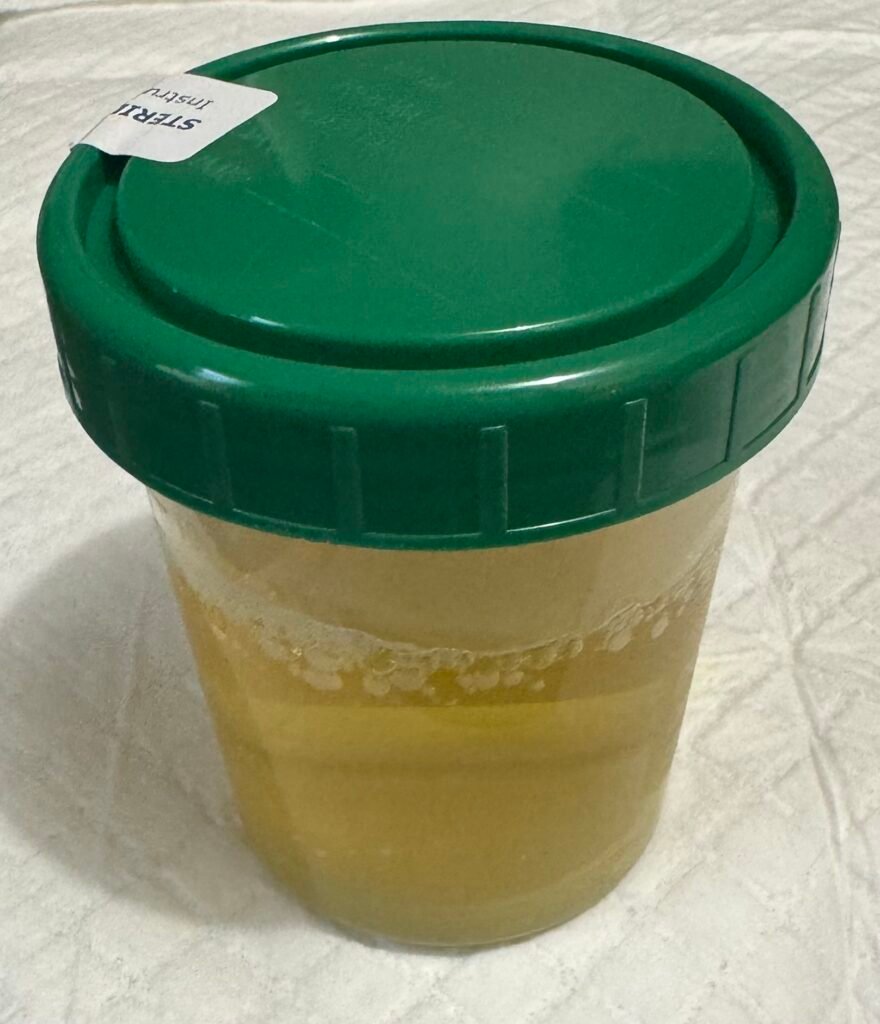
How to collect a clean-catch urine sample
- Wash your hands.
- Use the sterile container provided by the clinic or lab.
- Clean the genital area as instructed.
- Begin urinating into the toilet.
- Without stopping the stream, collect the middle portion of urine in the cup.
- Avoid touching the inside of the lid or container.
- Close the lid tightly and return the sample promptly.
Mayo Clinic notes that if a urine sample cannot be delivered to the designated area within about 60 minutes, it may need refrigeration unless the provider gives different instructions. Delays can affect cells, bacteria, ketones, and other components, so follow the lab’s handling directions carefully.
How to interpret common result patterns
Urinalysis interpretation is not just a checklist of “normal” and “abnormal.” A single abnormal item may be temporary or clinically minor, while a combination of findings can point toward a more important condition. The examples below are educational patterns, not diagnoses.
Blood positive, RBCs present
When the dipstick is positive for blood and microscopy shows red blood cells, this supports hematuria. The next question is why it is happening. The NIDDK lists possible causes of blood in urine including infection or inflammation of the bladder, kidney, urethra, or prostate; trauma; stones; recent urinary tract procedures; vigorous exercise; benign prostatic hyperplasia; kidney disease; blood-clotting disorders; sickle cell disease; and cancers of the bladder, kidney, or prostate.
Visible blood should be taken seriously even if it happens once, especially in adults. Microscopic blood may be approached differently depending on risk factors such as age, smoking history, degree of RBC elevation, prior episodes, and whether urinary symptoms are present.
Blood positive, few or no RBCs on microscopy
This pattern can occur when the dipstick reacts to hemoglobin or myoglobin rather than intact red blood cells, or when red blood cells break apart in dilute urine. It can also reflect false-positive dipstick results. Your clinician may repeat the test, review medications and recent exercise, and consider whether additional blood or muscle-enzyme testing is needed.
Blood plus leukocyte esterase, nitrites, bacteria, or white blood cells
This pattern can fit a urinary tract infection, especially if you have symptoms such as burning, urgency, frequent urination, lower abdominal discomfort, fever, or flank pain. The CDC lists bloody urine among possible UTI symptoms and recommends seeking medical care for UTI symptoms or any severe or concerning symptom. A urine culture may be ordered when the diagnosis is uncertain, symptoms are complicated, infection recurs, pregnancy is present, or initial treatment does not work.
A positive nitrite result is fairly specific for certain bacteria, but nitrite can be negative even when infection is present because not all bacteria produce nitrite and urine may not have remained in the bladder long enough. Leukocyte esterase suggests white blood cell activity, but inflammation is not always caused by a routine bacterial UTI.
Blood plus protein
Blood and protein together can raise concern for kidney involvement, especially if protein is more than trace, persistent, or accompanied by casts, high blood pressure, swelling, reduced kidney function, or abnormal blood creatinine. Dipstick protein is not the same as a quantitative urine albumin-to-creatinine ratio or protein-to-creatinine ratio. If protein persists, clinicians often order a more precise urine protein test and blood tests for kidney function.
Glucose or ketones in urine
Glucose is typically not detected in urine on routine dipstick testing. When present, it may be related to high blood glucose, pregnancy, kidney tubular handling of glucose, or SGLT2 inhibitor medications used for diabetes, heart failure, or kidney disease. Ketones can appear with fasting, prolonged vomiting, low-carbohydrate diets, pregnancy, uncontrolled diabetes, or serious illness. Urine glucose or ketones may require blood glucose or metabolic follow-up depending on the situation.
Abnormal specific gravity or pH
Specific gravity reflects urine concentration. A high value can occur with dehydration or concentrated urine; a low value can occur after high fluid intake or with impaired urine concentration. Urine pH varies with diet and physiology but can be useful when evaluating certain stone risks, infections, or kidney tubular conditions. These values are usually interpreted with the rest of the urinalysis rather than alone.
Follow-up and next steps
The right next step depends on why the urinalysis was ordered and what the full report shows. For example, a routine screening urinalysis with trace blood in a person who just exercised heavily may be handled differently from visible blood with clots, fever and flank pain, or persistent microscopic hematuria in an older adult with a smoking history.
| Situation | Common next step to discuss |
|---|---|
| Dipstick blood positive, microscopy not done | Repeat urinalysis with microscopy or confirmatory microscopic exam |
| Possible contaminated sample | Repeat clean-catch specimen, ideally away from menstruation or obvious contamination |
| UTI symptoms with WBCs, leukocyte esterase, nitrites, or bacteria | Clinical assessment; sometimes urine culture and antibiotic treatment based on risk factors |
| Persistent blood plus protein or casts | Kidney function blood tests, urine albumin/protein quantification, and possible nephrology evaluation |
| Visible blood in urine | Prompt medical evaluation; possible imaging, cystoscopy, urine culture, or specialist referral depending on risk |
| Pregnancy with suspected bacteriuria | Urine culture and pregnancy-specific management |
Pregnancy is a special case. The U.S. Preventive Services Task Force recommends screening pregnant persons for asymptomatic bacteriuria using urine culture, while recommending against screening nonpregnant adults who have no UTI symptoms. This is one reason a urine culture may be ordered in prenatal care even when a person feels well.
When to seek medical care promptly
- Visible red, pink, brown, or cola-colored urine
- Blood clots in urine or inability to urinate
- Fever, chills, flank or back pain, nausea, or vomiting
- Burning or urgency with pregnancy, kidney disease, diabetes, immune suppression, or a single kidney
- New swelling, high blood pressure, foamy urine, or reduced urine output
- Persistent microscopic blood on repeat testing
Limitations of urinalysis
Urinalysis is useful because it is quick, inexpensive, and information-rich, but it has limitations. A normal urinalysis does not rule out every kidney, bladder, prostate, metabolic, or infectious condition. An abnormal urinalysis does not automatically mean a serious disease is present.
False positives and false negatives can occur. The AAFP review notes that dipstick blood can be affected by exercise, hemoglobinuria, menses, myoglobinuria, high urine specific gravity, and vitamin C. Specimen delays, poor clean-catch technique, vaginal discharge, menstrual blood, dehydration, very dilute urine, antibiotics, and recent procedures can also complicate interpretation.
Another limitation is that urinalysis is often a snapshot. Blood, protein, ketones, or infection markers may appear temporarily and then resolve. Conversely, intermittent conditions may be missed if the urine sample is collected when the abnormality is not present. That is why repeat testing is common when an unexpected abnormal result appears.
Cost and access
Urinalysis is generally one of the lower-cost laboratory tests, but the amount a patient pays can vary widely. Cost depends on whether the test is performed in a clinic, urgent care, hospital, independent laboratory, prenatal visit, emergency department, or direct-to-consumer lab workflow. Insurance coverage, deductibles, facility fees, clinician visit charges, urine culture add-ons, and reflex microscopy can all change the final bill.
When comparing cash-pay options, compare the effective total cost, not just the advertised test price. Ask whether the price includes the clinician order, lab processing, specimen collection, microscopy, reflex testing, urine culture if indicated, result access, and any required service or processing fees. The CMS Clinical Laboratory Fee Schedule is one reference point for Medicare laboratory payment policy, but it is not the same as a consumer cash price and does not predict what every insurer, clinic, or hospital will bill.
If you are uninsured or using a high-deductible plan, ask for the CPT code, whether the order is for dipstick only or complete urinalysis with microscopy, and whether a urine culture could be added. A urine culture is a different test from urinalysis and usually costs more, but it may be necessary when infection needs confirmation or antibiotic selection.
FAQs
Is a urinalysis blood test a blood draw?
Usually, no. In this context, “blood” refers to a urinalysis result that checks for blood or red blood cells in urine. Some clinicians may also order blood tests, such as kidney function tests, if the urine result suggests a need for follow-up.
What does “trace blood” in urine mean?
Trace blood means the dipstick had a small positive reaction for blood. It may be temporary, due to contamination, or related to a medical condition. It should be interpreted with microscopy, symptoms, and repeat testing when appropriate.
Can dehydration cause blood on a urinalysis?
Dehydration can concentrate urine and may affect dipstick interpretation, but it should not be assumed to be the only explanation for confirmed red blood cells in urine. If blood persists or is visible, medical follow-up is important.
Can exercise cause blood in urine?
Yes. Vigorous exercise can cause temporary hematuria in some people. Clinicians may repeat urinalysis after a period without strenuous exercise to see whether it resolves. Persistent blood should not be dismissed as exercise-related without appropriate evaluation.
Does blood in urine always mean a UTI?
No. UTIs can cause blood in urine, especially with burning, urgency, frequency, pelvic discomfort, fever, or flank pain. But stones, kidney disease, prostate conditions, trauma, contamination, medications, and tumors can also be associated with blood in urine.
What is the difference between urinalysis and urine culture?
Urinalysis screens urine for chemical and microscopic clues such as blood, protein, white blood cells, nitrites, and bacteria. A urine culture attempts to grow and identify bacteria and can help guide antibiotic choice. A culture may be ordered when infection needs confirmation or symptoms are complicated.
What does RBC/HPF mean?
RBC/HPF means red blood cells per high-power field under the microscope. It is a microscopy measurement used to confirm and estimate the amount of blood cells in urine.
Can menstruation affect a urinalysis?
Yes. Menstrual blood can contaminate a urine sample and cause a positive blood result. If the result is unexpected and the timing could have affected the sample, a clinician may recommend repeating a clean-catch specimen at another time.
Should I treat bacteria in urine if I have no symptoms?
Not always. Screening and treatment decisions depend on the situation. For example, USPSTF recommends screening pregnant persons with urine culture for asymptomatic bacteriuria, but recommends against screening nonpregnant adults without symptoms. Do not start antibiotics without clinician guidance.
How long do urinalysis results take?
Dipstick results may be available quickly, sometimes during the same visit. Microscopy and laboratory-processed urinalysis may take longer. A urine culture, if ordered, often takes additional time because bacteria must be grown and identified.
Source Notes
- MedlinePlus — Urinalysis
- Mayo Clinic — Pac 20384907
- National Institute of Diabetes and Digestive and Kidney Diseases
- American Family Physician: Office-Based Urinalysis, A Comprehensive Review
- American Urological Association/Society of Urodynamics, Female Pelvic Medicine & Urogenital Reconstruction guideline
- CDC: Urinary Tract Infection Basics
- USPSTF: Asymptomatic Bacteriuria in Adults, Screening
- CMS: Clinical Laboratory Fee Schedule